Introduction
I spent more than forty-five years trying to understand why my body was falling apart.
Neck, back, hips, knees, hands, feet, tremors, tinnitus, skin changes, kidney cancer, autoimmune disease, and constant pain that only got worse. Every specialist had a different answer. None of them connected the dots. In 2017 and 2018 the VA ran ANA and IgG tests that came back abnormal — and no one ever told me. I only found out years later when I pulled my own records.
It wasn’t until late 2025, when I finally demanded answers and ran the right blood work myself, that the picture became clear. Positive ANA. Positive anti-CCP. Low IgG. Seropositive rheumatoid arthritis. And a lifetime of multi-system damage that lined up exactly with seven years of daily occupational exposure to trichloroethylene — open vats, parts cleaning, and living in Lakewood, Washington, on top of a contaminated aquifer.
That is the TCE Effect.
It is not one disease. It is a pattern of immunotoxicity, neurotoxicity, autoimmune dysregulation, organ damage, and progressive degeneration that the VA, military medicine and civilian health-care failed to recognize in real time. Thousands of us from the same era are living with the same pattern and still being told it is just aging or coincidence.
I wrote this Protocol so that no other veteran has to spend decades figuring it out alone.
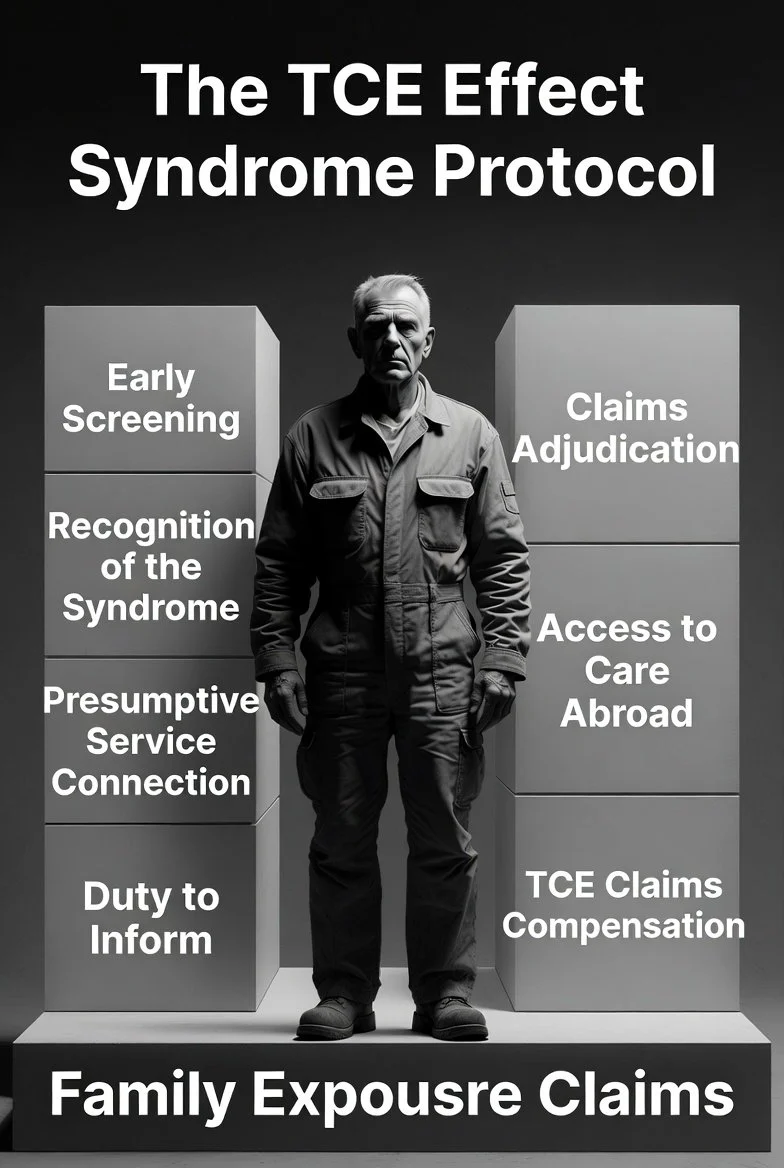
These eight pillars are the standards that should have been in place long ago — early screening, formal recognition of the syndrome, presumptive service connection, a real duty to inform, proper claims handling, clinician training, accountability and family recognition. They are written as policy language so they can be adopted and enforced.
This is what I needed when I was still trying to understand what was happening to me.
This is what every solvent-exposed veteran still needs today.
PILLAR 1 – MANDATORY EARLY SCREENING FOR TCE AND MILITARY SOLVENT EXPOSURE
Policy Statement:
The Department of Veterans Affairs shall establish and implement a mandatory, standardized screening protocol for all veterans with documented, probable, or self-reported occupational or environmental exposure to trichloroethylene (TCE) or other military solvents during their period of service.
Purpose:
To identify veterans at risk for the TCE Effect Syndrome at the earliest possible stage, before irreversible multi-system damage occurs, and to ensure timely diagnosis, treatment, and service-connected compensation.
Definitions:
TCE Exposure History includes, but is not limited to: Direct occupational contact with TCE or similar chlorinated solvents in Army motor pools, vehicle maintenance, recovery operations, parts cleaning, aircraft maintenance, shipboard maintenance and cleaning, weapons maintenance, and any other military occupational specialty involving regular use of solvents for degreasing, cleaning, or corrosion prevention. This includes both active duty and reserve component service. Probable periods of significant TCE exposure in the U.S. military include the 1940s through the late 1980s, with peak usage during the 1960s through 1980s.
TCE Effect Syndrome refers to the multi-system pattern of disease caused by TCE exposure, including but not limited to: autoimmune dysregulation, neurological damage (including tremors, Parkinson's and neuropathy), endocrine and pituitary disruption, multi-level degenerative disc and joint disease, kidney cancer, liver cancer, renal dysfunction, erectile dysfunction, skin disorders, dental destruction, and secondary conditions arising from these primary effects.
Requirements:
1. Mandatory Screening Trigger Points
The VA shall require TCE-specific screening at the following points:
Upon initial enrollment in VA healthcare for any veteran who reports or is identified as having TCE or solvent exposure.
For all veterans who served during the period of 1960 through 1989, automatic screening shall be triggered at the first point of contact with VA healthcare or claims, regardless of whether the veteran self-reports exposure.
At the time a veteran files a disability compensation claim involving any condition potentially related to TCE exposure (including but not limited to autoimmune, neurological, endocrine, orthopedic, renal, hepatic, or dermatological conditions).
During any Comprehensive Preventive Health Evaluation or periodic health assessment for veterans with known or probable exposure history.
Upon request by the veteran or their treating physician.
2.Required Screening Components
The mandatory screening protocol shall include, at minimum:
Detailed exposure history questionnaire covering occupational duties, duty locations, dates of service, and routes of exposure (direct contact, inhalation, and secondary/take-home exposure).
Comprehensive laboratory testing for autoimmune disorders, including but not limited to:
ANA (with titer and pattern)
ENA panel (for lupus and related connective tissue diseases)
Anti-CCP
Rheumatoid Factor (RF)
Total IgG and IgG subclasses
CRP, ESR, and other inflammatory markers as clinically indicated.
Neurological screening for tremors, neuropathy, cognitive changes, and balance issues.
Comprehensive endocrine evaluation, including hormonal panel and pituitary function assessment (TSH, Free T4, ACTH, cortisol, prolactin, IGF-1, FSH, LH, testosterone, and other hormones as clinically indicated).
Documentation of all prior surgeries, joint replacements, chronic pain conditions, and cancer history (with specific attention to kidney and liver cancers).
3. Documentation and Notification
All screening results shall be:
Documented in the veteran’s VA electronic health record under a dedicated “TCE Exposure” flag or problem list entry.
Provided to the veteran in writing within 30 days, including clear explanation of abnormal findings and recommended next steps.
Used to trigger automatic referral to rheumatology, neurology, endocrinology, nephrology, or other appropriate specialists as indicated.
Shared with the Veterans Benefits Administration (VBA) when a compensation claim is pending or has been filed.
4. Training Requirement
The VA shall develop and require mandatory training for all Primary Care, Compensation & Pension, Environmental Health, and Claims Adjudication personnel on the recognition of TCE exposure history, the TCE Effect Syndrome, and the required screening protocol.
Implementation:
The Secretary of Veterans Affairs shall issue implementing regulations and clinical practice guidelines within 180 days of enactment and shall report annually to Congress on screening rates, positive findings, referrals, and outcomes.
PILLAR 2 – RECOGNITION OF THE TCE EFFECT SYNDROME AS A MULTI-SYSTEM DISORDER
Policy Statement:
The Department of Veterans Affairs shall recognize and adjudicate disability claims arising from trichloroethylene (TCE) exposure as a multi-system disorder known as the TCE Effect Syndrome, rather than as a collection of isolated, unrelated conditions. The VA shall evaluate the totality of damage caused by TCE across all affected body systems when determining service connection, disability ratings, and treatment needs.
Purpose:
To ensure that veterans suffering from the widespread, interconnected effects of TCE exposure receive fair, consistent, and scientifically accurate adjudication of their claims. TCE is a known multi-organ toxicant that produces a recognizable pattern of injury across multiple body systems. Treating these effects as separate, unrelated claims results in unnecessary examinations, inconsistent ratings, and denial of just compensation.
Definitions:
TCE Effect Syndrome means the multi-system pattern of injury and disease caused by exposure to trichloroethylene (TCE) and related chlorinated solvents. TCE is a known immunotoxicant, neurotoxicant, carcinogen, reproductive toxicant, and endocrine disruptor. The TCE Effect Syndrome includes, but is not limited to, damage to the following body systems:
Immunotoxicity / Immune System: Autoimmune dysregulation (including seropositive rheumatoid arthritis, positive ANA, low IgG, and other autoimmune conditions), hypersensitivity syndromes, and increased susceptibility to infection and inflammation.
Musculoskeletal System: Accelerated degenerative disc disease (DDD), widespread osteoarthritis, joint destruction, bone-on-bone changes, and need for multiple joint replacements and spinal fusions.
Neurotoxicity / Nervous System: Essential tremors, peripheral neuropathy, cognitive impairment, balance disorders, and increased risk of Parkinson’s disease and other neurodegenerative conditions.
Ototoxicity / Auditory and Vestibular System: Hearing loss, tinnitus, and vestibular dysfunction.
Reproductive System: Erectile dysfunction, reduced libido, infertility, hormonal disruption, and adverse effects on fertility and sexual function.
Vascular / Cardiovascular System: Vascular damage, circulatory dysfunction, and increased cardiovascular risk.
Endocrine System: Pituitary dysfunction (including macroadenomas), thyroid disorders, and broader hormonal disruption.
Renal System: Kidney cancer (renal cell carcinoma), chronic kidney disease, and renal dysfunction.
Hepatic System: Liver damage and increased risk of liver cancer.
Dermatological / Skin System: Chemical sensitivity, skin rashes, purpura, accelerated aging of skin, and hypersensitivity reactions.
Oral System: Accelerated tooth decay, gum disease, and dental destruction linked to both direct solvent exposure and systemic immune dysregulation.
Cancers: Increased risk of kidney cancer, liver cancer, non-Hodgkin lymphoma, and other malignancies associated with TCE exposure.
Scientific Basis:
Trichloroethylene (TCE) has been extensively studied by leading national and international scientific bodies. The International Agency for Research on Cancer (IARC) classifies TCE as carcinogenic to humans (Group 1), with the strongest evidence for kidney cancer. The U.S. Environmental Protection Agency (EPA) has determined that TCE is carcinogenic to humans by all routes of exposure. The National Toxicology Program (NTP) lists TCE as a known human carcinogen. The Agency for Toxic Substances and Disease Registry (ATSDR) and the National Academies of Sciences, Engineering, and Medicine have documented strong evidence linking TCE exposure to kidney cancer, non-Hodgkin lymphoma, immune system dysfunction (including autoimmune disease), neurotoxicity, and other multi-system effects. These findings are based on occupational studies, animal research, and mechanistic evidence that together establish a clear causal relationship between TCE exposure and the pattern of injury known as the TCE Effect Syndrome.
Requirements:
1. Syndromic Evaluation Standard
When a veteran submits a claim involving one or more conditions associated with TCE exposure, the VA shall evaluate the claim under the TCE Effect Syndrome framework. Adjudicators shall consider the veteran’s full clinical picture as a single, exposure-related syndrome rather than requiring separate proof for each individual condition.
2. Qualifying Exposure Parameters
For purposes of this Protocol, qualifying TCE exposure includes:
Occupational Exposure: Direct and regular contact with TCE or similar chlorinated solvents in military motor pools, vehicle and aircraft maintenance, recovery operations, parts cleaning, weapons maintenance, shipboard maintenance, and any other military occupational specialty involving degreasing or corrosion prevention. Significant occupational use of TCE in the U.S. military occurred primarily from the 1940s through the late 1980s, with peak usage during the 1960s through 1980s.
Environmental / Drinking Water Exposure: Residence, work, or prolonged presence on or near military installations where TCE or related solvents contaminated on-base wells, drinking water systems, or surrounding community aquifers. This includes exposure that continued for years or decades after official TCE use had ceased, due to persistent groundwater contamination (as documented at Camp Lejeune, North Carolina, where contamination affected drinking water from the early 1950s through December 31, 1987).
3. Medical Opinion Requirements
All Compensation & Pension (C&P) medical opinions and Disability Benefits Questionnaires (DBQs) concerning TCE-exposed veterans shall address whether the veteran’s conditions are consistent with the TCE Effect Syndrome and the likelihood that TCE exposure caused or contributed to the overall multi-system pattern of disease.
4. Training and Guidance
The VA shall develop and require mandatory training for all VBA adjudicators, C&P examiners, and Environmental Health clinicians on the multi-system nature of TCE toxicity, the TCE Effect Syndrome, and the qualifying exposure parameters described above.
5. Presumptive Service Connection
Where scientific evidence supports it, the Secretary shall establish presumptive service connection for conditions and patterns of disease falling under the TCE Effect Syndrome for veterans with qualifying occupational or environmental TCE exposure during military service.
Implementation:
The Secretary of Veterans Affairs shall issue implementing regulations, clinical practice guidelines, and training curricula within 180 days of enactment. The VA shall report annually to Congress on claims adjudicated under this framework.
PILLAR 3 – PRESUMPTIVE SERVICE CONNECTION FOR TCE EXPOSURE AND THE TCE EFFECT SYNDROME
Policy Statement:
The Department of Veterans Affairs shall establish presumptive service connection for the TCE Effect Syndrome and specified conditions associated with trichloroethylene (TCE) exposure for veterans who meet the qualifying exposure criteria set forth in this Protocol. Once a veteran establishes qualifying TCE exposure, the VA shall presume that the TCE Effect Syndrome and associated conditions are caused by that exposure. The burden shall not be on the veteran to prove causation on a case-by-case basis.
Purpose:
To eliminate the repeated, unnecessary, and often impossible burden placed on TCE-exposed veterans to prove that their multi-system disease was caused by TCE exposure. This Pillar shifts the burden of proof to the VA and ensures that veterans who served during periods and in locations of known TCE use and contamination receive fair and timely adjudication of their claims without having to repeatedly prove what the government already knows.
Definitions:
Qualifying TCE Exposure means:
Occupational Exposure: Regular and direct contact with TCE or similar chlorinated solvents in the performance of military duties, including but not limited to motor pool operations, vehicle and aircraft maintenance, recovery operations, parts cleaning, weapons maintenance, shipboard maintenance and cleaning, and any other military occupational specialty involving degreasing, corrosion prevention, or solvent use. Qualifying occupational exposure occurred primarily from the 1940s through the late 1980s, with peak usage during the 1960s through 1980s.
Environmental / Drinking Water Exposure: Residence, work, training, or prolonged presence on or near a military installation where TCE or related solvents contaminated on-base drinking water systems, wells, or surrounding community aquifers. This includes exposure that continued for years or decades after official TCE use had ceased due to persistent groundwater contamination. A qualifying example includes the drinking water contamination at Marine Corps Base Camp Lejeune, North Carolina, and any other installation with documented TCE aquifer contamination affecting service members, their families, and surrounding communities.
TCE Effect Syndrome has the same meaning as defined in Pillar 2 of this Protocol.
Requirements:
1.Establishment of Presumptive Service Connection
The VA shall presume that the following conditions and patterns of disease are caused by TCE exposure when a veteran establishes qualifying TCE exposure under this Protocol:
The TCE Effect Syndrome as a whole (multi-system disease)
Kidney cancer (renal cell carcinoma)
Liver cancer
Non-Hodgkin lymphoma
Autoimmune diseases and immune system dysregulation (including but not limited to seropositive rheumatoid arthritis, positive ANA with clinical findings, and related autoimmune conditions)
Parkinson’s disease and other neurodegenerative conditions
Essential tremors and peripheral neuropathy
Multi-level degenerative disc disease and widespread osteoarthritis with or without surgical intervention
Pituitary dysfunction and other endocrine disorders
Erectile dysfunction and other reproductive system disorders
Chronic kidney disease (including in single-kidney veterans)
Any other condition the Secretary determines, through regulation, is associated with TCE exposure
2.Benefit of the Doubt
In any claim involving a veteran with qualifying TCE exposure, the VA shall apply the benefit of the doubt in favor of the veteran when there is an approximate balance of positive and negative evidence regarding service connection or disability rating. The VA shall not require the veteran to produce additional scientific or medical evidence of causation beyond establishing qualifying exposure and the presence of one or more conditions associated with the TCE Effect Syndrome.
3. Prohibition on Fragmented Claims Processing
The VA shall not require a veteran with qualifying TCE exposure to file or defend multiple separate claims for conditions that are part of the TCE Effect Syndrome. All such conditions shall be developed and rated under a single claim framework recognizing the multi-system nature of TCE toxicity.
4.Rebuttal Standard
The presumption established under this Pillar may only be rebutted by clear and convincing evidence that the veteran’s condition was caused by a factor or factors unrelated to TCE exposure. The mere absence of a specific diagnosis in service treatment records shall not be sufficient to rebut the presumption.
5. Training Requirement
The VA shall develop and require mandatory training for all VBA adjudicators and C&P examiners on the qualifying exposure criteria, the TCE Effect Syndrome, and the presumptive service connection requirements established under this Pillar.
Implementation:
The Secretary of Veterans Affairs shall issue implementing regulations within 180 days of enactment. The VA shall report annually to Congress on the number of claims granted and denied under this presumptive framework and the reasons for any denials.
PILLAR 4 – DUTY TO PROACTIVELY INFORM VETERANS OF THE TCE EFFECT SYNDROME
The Department of Veterans Affairs, and the United States Government more broadly, have an affirmative, ongoing duty to proactively identify and inform veterans who have qualifying service history that their multi-system conditions may be caused by or related to the TCE Effect Syndrome. This duty exists regardless of whether the veteran has filed a claim, reported symptoms, or enrolled in VA healthcare.
Purpose:
For decades, veterans exposed to trichloroethylene (TCE) during military service have suffered progressive, multi-system disease without ever being informed by the VA or the Government that their conditions could be explained by their service-related TCE exposure.
By the late 1970s and early 1980s, federal agencies including the Environmental Protection Agency (EPA), the National Institute for Occupational Safety and Health (NIOSH), and the National Institutes of Health (NIH) had substantial scientific evidence that TCE was a toxic substance capable of causing serious long-term harm, including carcinogenicity, immunotoxicity, neurotoxicity, and damage to multiple organ systems. Despite this growing body of knowledge, the Government failed to proactively warn or screen the very veterans who had been heavily exposed during their military service.
As a result, countless veterans have endured 40 to 50 years of unnecessary suffering, delayed diagnosis, progressive disability, and denied benefits. The TCE Effect Syndrome should have been recognized and affected veterans should have been notified years earlier. The Government and the VA owe these veterans accountability from the earliest reasonable point in time when they knew, or reasonably should have known, of the risks.
Definitions:
Qualifying Service History has the same meaning as defined in Pillar 3 of this Protocol.
TCE Effect Syndrome has the same meaning as defined in Pillar 2 of this Protocol.
Requirements:
1.Proactive Identification of At-Risk Veterans
The VA shall develop and maintain systems to identify veterans with qualifying service history, including but not limited to:
Veterans who served in military occupational specialties involving vehicle, aircraft, ship, or weapons maintenance.
Veterans who resided in on-base or off-base housing known or suspected to have TCE-contaminated drinking water.
Veterans who file claims or receive treatment for conditions consistent with the TCE Effect Syndrome.
2.Mandatory Notification Requirement
The VA shall proactively notify identified veterans, in clear and understandable language, that:
Their period and type of military service placed them at risk for TCE exposure.
TCE is a known multi-system toxicant that can cause the TCE Effect Syndrome.
Their current or developing multi-system conditions (autoimmune, neurological, musculoskeletal, endocrine, renal, hepatic, reproductive, dermatological, and others) may be caused by or contributed to by their TCE exposure during service.
These veterans are entitled to service-connected compensation, healthcare, and specialized evaluation under the TCE Effect Protocol.
This notification shall occur at the following trigger points, at minimum:
Upon initial enrollment in VA healthcare for any veteran with qualifying service history.
When a veteran files a disability compensation claim for any condition that could be part of the TCE Effect Syndrome.
During any Comprehensive Preventive Health Evaluation or periodic health assessment.
When abnormal laboratory findings consistent with autoimmune dysregulation, neurological issues, or other TCE-related conditions are identified.
Upon request by the veteran or their treating physician.
3. Content and Delivery of Notification
Notifications shall:
Be written in plain, non-technical language that a layperson can understand.
Clearly explain the connection between the veteran’s service history and the TCE Effect Syndrome.
Include information on how to pursue evaluation, claims, and care under this Protocol.
Be provided in writing and, when possible, discussed in person or by telephone with a knowledgeable VA clinician or claims representative.
Be documented in the veteran’s electronic health record and claims file.
4.Prohibition on Passive or Buried Disclosure
The VA shall not satisfy its duty to inform by simply placing general information on a website, in a pamphlet rack, or in fine print within other documents. The duty requires affirmative, targeted outreach to identified veterans.
5. Consequences for Failure to Inform
When the VA or the Government fails to fulfill its duty to proactively inform a veteran with qualifying service history, and that veteran later establishes service connection for conditions under the TCE Effect Syndrome, the following remedies shall apply:
The VA shall assign an effective date for benefits no later than the date the veteran was discharged from military service, or the date the veteran first became symptomatic with conditions consistent with the TCE Effect Syndrome, whichever is earlier.
In cases where the veteran can demonstrate that the Government possessed scientific knowledge of TCE’s multi-system effects during or shortly after the veteran’s period of service, the effective date shall be set to the earliest date permitted by law, giving full consideration to when the Government knew or reasonably should have known of the risks.
The VA shall provide expedited claims processing and priority handling for all claims filed under the TCE Effect Protocol.
Repeated or systemic failures to inform identified veterans shall be documented and may be considered in any administrative, congressional, or legal review of the veteran’s case.
The VA shall not use its own failure to inform as a basis to limit or reduce benefits, ratings, or effective dates.
Implementation:
The Secretary of Veterans Affairs shall issue implementing regulations, identification protocols, notification templates, and training requirements within 180 days of enactment. The VA shall report annually to Congress on compliance with this Pillar and on the number of veterans who receive earlier effective dates as a result of the Government’s prior failure to inform.
PILLAR 5 – EVIDENCE-BASED CLAIMS ADJUDICATION AND ANTI-FRAGMENTATION
Policy Statement:
The Department of Veterans Affairs shall develop, rate, and adjudicate disability compensation claims based on the evidence submitted by the veteran. The VA shall ensure that all submitted evidence, including Nexus letters, medical records, and scientific documentation, is properly reviewed prior to any Compensation and Pension (C&P) examination. Claims involving multi-system conditions, including the TCE Effect Syndrome, shall be adjudicated as interconnected disorders rather than as fragmented, isolated conditions.
Purpose:
Veterans routinely submit comprehensive claim packets that include Nexus letters, laboratory results, imaging, service records, and scientific evidence. Despite this, many veterans are still required to attend multiple C&P examinations where the examiner has not reviewed the submitted evidence. This forces veterans to repeatedly explain their conditions and teach examiners during the exam itself. This practice wastes time, increases frustration, delays decisions, and undermines the purpose of submitting evidence in the first place. The VA has a duty to ensure that submitted evidence is actually reviewed and considered before requiring additional examinations.
Current Failures:
Examiners frequently admit they have not reviewed the veteran’s full claim file or Nexus evidence prior to the examination.
Veterans are forced to educate examiners about their conditions and the relevant science during the exam.
Multiple unnecessary examinations are scheduled even when strong, well-documented evidence has already been submitted.
Veterans living outside the United States face additional barriers, including limited or no access to certain examinations due to geography.
The current system places the burden on the veteran to prove their case repeatedly instead of requiring proper preparation by examiners.
Requirements:
1.Examiner Preparation Requirement
Prior to any C&P examination, the examiner shall review the veteran’s complete claim file, including all submitted Nexus letters, medical records, and supporting evidence. The VA shall implement a process to confirm and document that the examiner has reviewed the key evidence before the examination is conducted.
2. Adjudication of Multi-System Claims
Claims involving the TCE Effect Syndrome or other multi-system conditions shall be developed and rated as interconnected disorders. The VA shall not fragment these claims into numerous separate issues requiring multiple independent examinations when the conditions are clearly related.
3. Reduction of Unnecessary Examinations
When a veteran has submitted a comprehensive claim packet with strong Nexus evidence, the VA shall not routinely require additional C&P examinations unless there is a specific, documented reason why the submitted evidence is insufficient.
4.Medical Opinion Requirements
All C&P medical opinions shall address the evidence already submitted by the veteran, including Nexus letters and scientific documentation. Opinions that ignore or fail to consider submitted evidence shall be considered deficient.
5. Training and Competency Requirements
Examiners conducting examinations for complex or multi-system claims shall receive specific training on the relevant medical conditions and evidence review standards. For toxic exposure claims, examiners shall be familiar with the established science regarding the claimed conditions.
6.Overseas Veterans
The VA shall develop reasonable alternatives for veterans residing outside the United States, including telehealth, telephone examinations, or the use of qualified local examiners, to prevent geographic discrimination in the claims process.
7.Accountability
When an examiner fails to review submitted evidence or conducts an examination without proper preparation, and this failure is documented, the VA shall take appropriate corrective action, including additional training or removal from complex claim examinations.
Implementation:
The Secretary of Veterans Affairs shall issue regulations and implement the examiner preparation and documentation requirements within 180 days. The VA shall provide annual reports to Congress on compliance with this Pillar, including data on the number of examinations conducted where examiners confirmed review of submitted evidence.
PILLAR 6 – ACCESS TO CARE AND BENEFITS FOR VETERANS RESIDING OUTSIDE THE UNITED STATES
Policy Statement:
The Department of Veterans Affairs shall ensure that veterans who reside outside the United States have meaningful and equitable access to the benefits, claims process, and medical care they earned through military service. Geographic location shall not be used to restrict or deny participation in the VA disability claims process or access to care for service-connected conditions.
Purpose:
Tens of thousands of U.S. veterans currently live outside the United States. These veterans face significant and unnecessary barriers when attempting to access VA benefits and care. These barriers include automatic blocking of Telehealth examinations, cancellation of scheduled C&P exams based solely on country of residence, lack of meaningful claims assistance, and failure to deliver critical benefit notices. These failures create geographic discrimination and must be corrected.
Current Failures:
Veterans living outside the United States have had Telehealth C&P examinations automatically blocked when the system detected they were located in Mexico.
Contractors have canceled scheduled C&P examination appointments upon learning the veteran resided in Mexico, claiming the veteran was “out of jurisdiction.”
There is virtually no meaningful access to accredited Veterans Service Officers or claims assistance by phone through VA channels for veterans living abroad. VA correspondence itself states that “free” assistance is generally limited to veterans located in the continental United States or its territories. In contrast, some Veterans Service Organizations, such as the DAV, have been willing to assist veterans living overseas.
The VA has sent critical benefit notices to unauthorized addresses in Mexico, resulting in veterans never receiving important information.
In practice, many veterans living overseas feel forced to maintain a U.S. mailing address to ensure delivery of important mail.
The VA has failed to implement verified delivery methods before taking adverse actions that could reduce or terminate benefits.
Requirements:
1.C&P Examination Access
The VA shall ensure that veterans living outside the United States have reasonable access to C&P examinations. Automatic blocking of Telehealth based on geographic location shall not be permitted. Reasonable alternatives, including telehealth, telephone examinations, or qualified local examiners, shall be made available when appropriate.
2. Claims Assistance for Overseas Veterans
The VA shall provide meaningful access to claims assistance for veterans living overseas, including by phone and secure electronic means. Restrictions on assistance shall not be applied in a manner that disadvantages veterans based solely on their country of residence.
3.Mailing Address and Correspondence
The VA shall accept and properly process claims and correspondence using the veteran’s chosen mailing address whether in the U.S. or overseas. The VA shall not require veterans to maintain a U.S. mailing address in order to receive important notices or participate in the benefits system. The VA shall implement procedures to ensure critical benefit notices are delivered through verified methods
4. Protection Against Adverse Actions
Before the VA takes any action that could reduce or terminate benefits, the veteran must receive verified delivery of the notice with adequate time to respond. Sending notices to unauthorized or previously problematic addresses shall not be considered sufficient notice.
5.Modernization of the Foreign Medical Program
The VA shall modernize the Foreign Medical Program by eliminating reliance on outdated paper-based processes and implementing timely electronic submission and reimbursement systems.
6.Clear Communication of Rights
The VA shall proactively and clearly inform all veterans of their rights and available options when residing outside the United States.
Implementation:
The Secretary of Veterans Affairs shall develop and implement policies to eliminate geographic barriers for veterans living outside the United States within 180 days. The VA shall provide annual public reports to Congress detailing progress on access to examinations, claims assistance, correspondence delivery, and the Foreign Medical Program for veterans residing abroad.
PILLAR 7 – ESTABLISHMENT OF THE TCE EFFECT SYNDROME AS A DISTINCT VA DISABILITY WITH TIERED SPECIAL MONTHLY COMPENSATION
Policy Statement:
The Department of Veterans Affairs shall recognize the TCE Effect Syndrome as a distinct, multi-system disability resulting from trichloroethylene exposure. Veterans diagnosed with the TCE Effect Syndrome shall receive a base schedular rating of 100 percent, with additional Special Monthly Compensation awarded in clear tiers based on the number of body systems affected and the level of functional impairment caused by the condition. Special Monthly Compensation under SMC-K shall be automatically awarded when erectile dysfunction or testicular hypofunction is present as part of the TCE Effect Syndrome.
Purpose:
Veterans exposed to TCE during military service often develop a wide range of interconnected and progressive conditions affecting multiple body systems. These include damage to the immune, neurological, musculoskeletal, endocrine, sensory, reproductive, and mental health systems, as well as increased risk of cancers. Over time, this multi-system damage causes severe chronic pain, loss of function, and profound limitations in daily life. Establishing the TCE Effect Syndrome as its own distinct disability with a minimum 100 percent rating, along with tiered Special Monthly Compensation and automatic SMC-K for erectile dysfunction and testicular issues, will provide fair compensation that reflects the true scope of harm caused by TCE exposure.
Current Failures:
The VA does not recognize the TCE Effect Syndrome as a single, distinct condition.
Veterans with widespread TCE-related damage across multiple body systems are forced to file and defend dozens of separate claims.
Special Monthly Compensation, including SMC-K for erectile dysfunction and testicular issues, is rarely granted automatically even when these conditions are clearly linked to TCE exposure.
The current system fails to properly compensate veterans for the cumulative pain, functional loss, and destruction of quality of life caused by multi-system TCE damage.
Requirements:
1.Recognition of the TCE Effect Syndrome
The VA shall establish the TCE Effect Syndrome as a distinct diagnostic entity for disability compensation purposes.
2. Base Rating
Veterans diagnosed with the TCE Effect Syndrome shall be assigned a minimum schedular disability rating of 100 percent.
3.Automatic SMC-K
Veterans diagnosed with the TCE Effect Syndrome who also have erectile dysfunction or testicular hypofunction shall be automatically entitled to Special Monthly Compensation under SMC-K.
4.Tiered Special Monthly Compensation
In addition to the base 100 percent rating and automatic SMC-K, veterans shall receive additional Special Monthly Compensation based on the following tiers. These tiers are determined by how many body systems are affected and how severely the veteran’s ability to function and live a normal life has been impacted:
Tier 1 SMC: The veteran has significant damage across multiple body systems and experiences substantial functional impairment. Daily activities are difficult and often painful. Quality of life is noticeably reduced.
Tier 2 SMC: The veteran has widespread damage across multiple body systems and experiences severe functional impairment. Most daily activities require significant effort or cause severe pain. The veteran’s ability to engage in normal personal, social, or family activities is heavily restricted.
Tier 3 SMC: The veteran has severe, multi-system failure across numerous body systems and experiences extreme functional impairment. Almost all normal daily activities are either impossible or cause unbearable pain. The veteran has lost the ability to live independently or maintain basic personal and family relationships.
See - APPENDIX A – TIER DETERMINATION GUIDELINES FOR THE TCE EFFECT SYNDROME
5.Separate and Additional Rating
The TCE Effect Syndrome rating and its associated Special Monthly Compensation (including automatic SMC-K) shall be separate from and in addition to any other service-connected disabilities. This ensures the condition is clearly recognized on its own, which is necessary for proper claims processing and access to benefits, especially for veterans living outside the United States.
6. Presumptive Service Connection
The VA shall establish presumptive service connection for the TCE Effect Syndrome for veterans with qualifying TCE exposure during military service.
Implementation:
The Secretary of Veterans Affairs shall develop and implement regulations establishing the TCE Effect Syndrome as a distinct disability with a base 100 percent rating, automatic SMC-K for erectile dysfunction and testicular issues, and the tiered Special Monthly Compensation structure within 180 days. The VA shall provide annual reports to Congress on the number of veterans rated under this Pillar and the compensation awarded.
APPENDIX A – TIER DETERMINATION GUIDELINES FOR THE TCE EFFECT SYNDROME
This appendix provides guidance for determining which tier of Special Monthly Compensation (SMC) a veteran qualifies for under the TCE Effect Syndrome. The determination is based on two main factors:
1. Number of body systems significantly affected by TCE-related damage.
2. Level of functional impairment and suffering experienced by the veteran in daily life.
Step 1:Identify Affected Body Systems
The following body systems are commonly impacted by long-term TCE exposure. A system is considered “significantly affected” when there is documented medical evidence of damage or dysfunction that is reasonably linked to TCE exposure:
Musculoskeletal System (spine, joints, muscles, chronic pain syndromes, post-surgical complications, osteoarthritis)
Neurological System (neuropathy, radiculopathy, tremors, cognitive issues, Parkinson’s disease)
Autoimmune / Immune System (rheumatoid arthritis, fibromyalgia, immune dysregulation, osteoarthritis)
Endocrine System (pituitary disorders, hormonal imbalances, testicular hypofunction)
Sensory System (hearing loss, tinnitus, vision changes)
Reproductive System (erectile dysfunction, sexual dysfunction, testicular issues)
Mental Health System (depression, anxiety, mood disorders secondary to chronic illness and pain)
Other Systems (gastrointestinal, cardiovascular, dermatological, kidney cancer, liver cancer, lipomas, and cysts when linked to TCE exposure)
Note: The more systems that are significantly affected, the higher the potential tier.
Step 2:Assess Level of Functional Impairment and Suffering
Use the following questions to evaluate how severely the veteran’s life is impacted:
Does the veteran experience severe or constant pain that limits or prevents normal daily activities?
Can the veteran perform basic self-care (bathing, dressing, eating, toileting) without significant pain or assistance?
Is the veteran able to engage in normal social, family, or personal activities (seeing children/grandchildren, hobbies, relationships)?
Does the veteran require frequent rest periods or assistance due to pain or fatigue?
Has the veteran lost the ability to work or maintain independence?
Does the veteran experience progressive worsening across multiple systems over time?
Tier Determination Criteria
Tier 1 SMC
The veteran has significant involvement of 3 or more body systems and experiences moderate to severe functional impairment. Daily activities are difficult and often painful. Quality of life is noticeably reduced, but the veteran can still perform most basic self-care with effort.
Tier 2 SMC
The veteran has widespread involvement of 4 or more body systems and experiences severe functional impairment. Most daily activities require significant effort or cause severe pain. The veteran’s ability to engage in normal personal, social, or family activities is heavily restricted. Independence is substantially compromised.
Tier 3 SMC
The veteran has severe, multi-system failure across 5 or more body systems and experiences extreme functional impairment. Almost all normal daily activities are either impossible or cause unbearable pain. The veteran has lost most or all ability to live independently and maintain basic personal and family relationships.
Note to Raters:
When determining the appropriate tier, consider the cumulative impact across all affected systems rather than evaluating each condition in isolation. Progressive worsening over time and documented functional decline should be given significant weight. Special consideration should be given when cancers (such as kidney or liver cancer), Parkinson’s disease, or widespread lipomas and cysts are present as part of the TCE Effect Syndrome.
PILLAR 8 – COMPENSATION FOR FAMILY MEMBERS SECONDARILY EXPOSED TO TCE
Policy Statement:
The Department of Veterans Affairs shall provide compensation and benefits to eligible family members of veterans who qualify for the TCE Effect Syndrome when those family members developed TCE-related conditions due to secondary exposure. Secondary exposure includes, but is not limited to, living in contaminated base housing, drinking contaminated water on or near military installations, and exposure through contact with a veteran’s TCE-contaminated clothing and personal items. Compensation shall be awarded based on the severity of the family member’s condition and shall be subject to annual review upon request by the qualifying family member. Qualifying family members shall also receive full CHAMPVA coverage with no copays for medical care or pharmacy.
Purpose:
Many veterans who were exposed to TCE during military service unknowingly exposed their spouses and children through secondary routes. Family members who lived with the veteran during periods of TCE exposure on base or in contaminated housing areas have developed serious conditions, including autoimmune dysregulation, Parkinson’s disease, cancers, and other TCE-related illnesses. These family members have suffered without recognition or compensation. This Pillar establishes a framework to identify and compensate eligible family members using existing VA dependent records, with compensation levels based on the severity of their conditions, the ability to request annual reviews, and full CHAMPVA coverage with no copays.
Current Failures:
Family members who were secondarily exposed to TCE have no formal path to compensation, even when they develop well-documented TCE-related conditions.
The VA has failed to recognize secondary exposure as a legitimate basis for benefits.
There is currently no mechanism to use existing VA dependent records to proactively identify and notify potentially eligible family members.
Family members have no ability to have their compensation level reviewed as their conditions worsen over time.
Family members of TCE-exposed veterans do not currently receive full CHAMPVA coverage with no copays.
Requirements:
1. Recognition of Secondary Exposure
The VA shall formally recognize secondary TCE exposure (through contaminated housing, water, or a veteran’s clothing and personal effects) as a valid basis for compensation when a family member develops TCE-related conditions.
2. Eligible Family Members
Compensation under this Pillar shall be available to spouses and children who lived with a qualifying veteran during periods of known or likely TCE exposure and who have developed autoimmune dysregulation, Parkinson’s disease, cancers, or other conditions scientifically linked to TCE exposure.
3. Use of Existing VA Records
The VA shall use existing dependent records to identify family members who lived with a veteran during qualifying TCE exposure periods and proactively notify them of potential eligibility for benefits under this Pillar.
4. Tiered Compensation Based on Condition Severity
Compensation for eligible family members shall be awarded based on the severity of their TCE-related condition(s), following a rating structure similar to that used for veterans. More severe conditions (such as cancer, Parkinson’s disease, or severe autoimmune disease) shall receive higher levels of compensation.
5. Annual Review Option
Qualifying family members shall have the right to request a review of their compensation level on an annual basis. The VA shall conduct the review and adjust compensation if the family member’s condition has worsened.
6. Full CHAMP VA Coverage with No Copays
Qualifying family members shall automatically receive full CHAMPVA coverage with no copays for doctors, medical care, or pharmacy services.
7.Presumptive Service Connection for Family Members
The VA shall establish presumptive service connection for qualifying family members who develop autoimmune dysregulation, Parkinson’s disease, cancers, or other TCE-related conditions when the veteran has been granted benefits under the TCE Effect Syndrome.
8.Claims Process for Family Members
The VA shall create a simplified claims process for eligible family members, allowing them to file for compensation based on their relationship to a veteran who has been granted benefits under the TCE Effect Syndrome.
Implementation:
The Secretary of Veterans Affairs shall develop and implement regulations to provide compensation to eligible family members secondarily exposed to TCE within 180 days. The VA shall provide annual reports to Congress on the number of family members identified, compensated, and reviewed under this Pillar.
Conclusion
I am a seventy year old Disabled American Veteran.
I have lived with the consequences of trichloroethylene (TCE) exposure for most of my adult life. I have lost a kidney to cancer. I have undergone multiple spine and other surgeries. I live with rheumatoid arthritis, widespread degenerative disease, neuropathy, tremors, tinnitus, and pain that never ends. My wife carries secondary effects. One of my sons has Parkinson’s. My daughter has her own set of problems that began in the same contaminated environment.
I did not get the answers from the system that was supposed to protect me. I got them because I kept digging after the system stopped looking.
That is why this Protocol exists.
It is not theory. It is not academic. It is the standard of care and claims practice that should have been applied to every veteran who worked with open-vat solvents and lived near contaminated water. Early screening. Honest communication of abnormal labs. Recognition that this is a multi-system disease. Presumptive service connection. Real accountability when the duty to inform is ignored.
I will not accept that the next generation of solvent-exposed veterans has to go through what I went through.
I will not accept that abnormal labs stay buried in a file.
I will not accept that multi-system toxic injury continues to be treated as a collection of unrelated conditions.
This Protocol is the line in the sand.
If the Department of Veterans Affairs and the people who oversee it adopt these standards, real change and help is possible. If they do not, then the same pattern of silence, delay, and denial will keep destroying lives the way it has destroyed mine and so many others.
I know what this chemical did to me.
I know what it’s still doing to me.
I know what it is doing to others.
The only question left is whether the system finally decides to act like it knows it too.
Thank You for Your Attention to This Matter… {former} Motor Sergeant, Sgt. Scott Olsen